INFO CENTER
30 Years Manufacturing And Export Experience In Money Handling Equipment
Language
Banknote fitness is a judgment about whether a note's current physical condition meets the applicable standard for recirculation. A note's age alone cannot answer that question. Professional cash handlers also need to establish authenticity and check whether the note's series remains eligible for their recirculation process.
For banks, cash centers and cash-in-transit operators, the practical task is to separate cash that can be used again from cash that needs another handling route. That requires clear standards, suitable equipment and a defined process for exceptions.
Fitness describes a note's condition at the time of inspection. Common concerns include soil, stains, tears, missing sections and repairs. Authenticity asks a different question: is the note genuine? A genuine note may be unfit, while an apparently clean note may still require authentication review.
The Federal Reserve distinguishes "fit" from "fit for commerce". A note that falls short of the Fed's redistribution standard may still be acceptable in everyday transactions. An unfit classification therefore does not, by itself, mean that a note has no value.
For a cash operation, the useful question is: does this note meet the standard that applies to its intended next use? The answer should come from the relevant rules and inspection process.
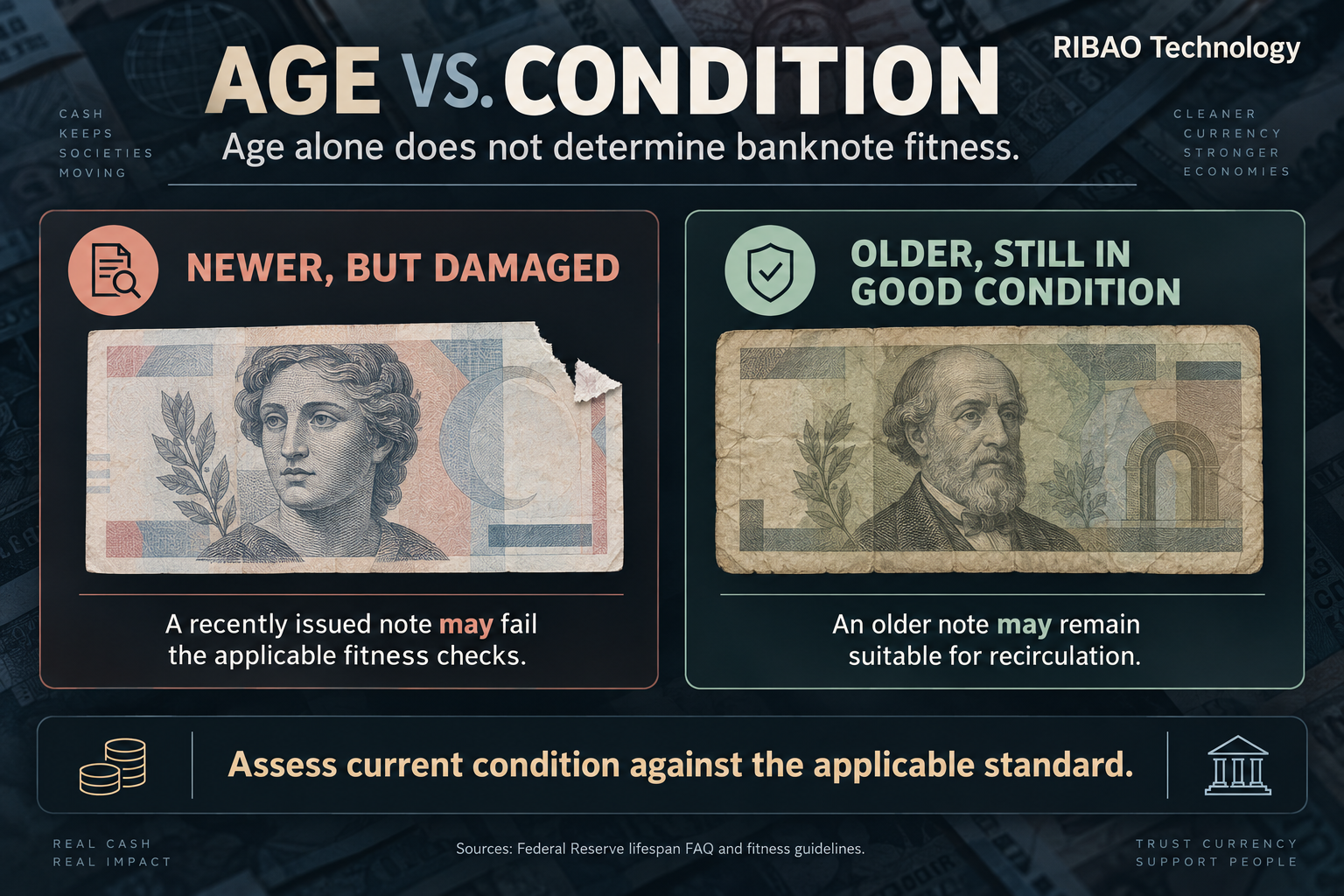
Banknote lifespan is an estimate of how long notes remain in circulation. Fitness is a decision about an individual note's condition now. A recently issued note can become unfit through damage; an older note can remain suitable for recirculation if it passes the applicable checks.
The Federal Reserve's estimates as of May 2025 illustrate how average lifespan varies by denomination:
| U.S. denomination | Estimated average lifespan |
|---|---|
| $1 | 7.2 years |
| $20 | 11.1 years |
| $100 | 24.0 years |
These are selected population averages, not expiry dates. The Fed explains that its processing equipment assesses deposited notes: those meeting quality standards continue circulating, while those failing them are removed and destroyed. This process determines lifespan.
Average lifespan can provide planning context. It should not become an instruction to retire a particular note after a set number of years.
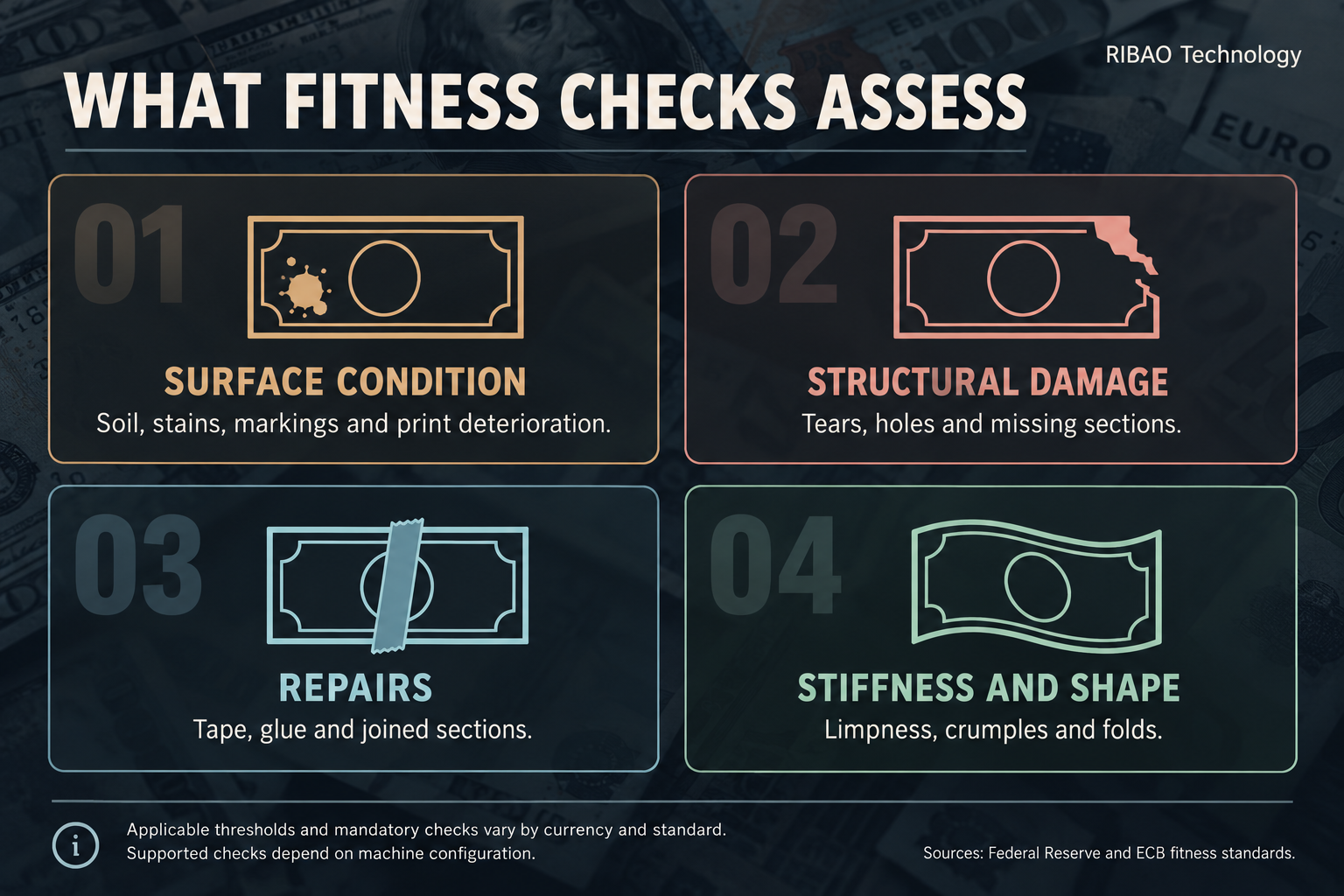
The Federal Reserve fitness guidelines and the ECB's automated fitness standards describe several kinds of deterioration. The categories below are a practical overview, rather than a universal test specification.
| Condition | What may be assessed |
|---|---|
| Soil and stains | General dirt accumulation or localized discoloration. |
| Tears, holes and missing parts | Damage to the note's physical integrity. |
| Repairs | Tape, glue or other attempts to join damaged sections. |
| Limpness and deformation | Loss of stiffness, crumpling or folds. |
| Graffiti and print deterioration | Added markings or loss of printed detail. |
A standards document listing a defect does not automatically require every machine to detect it. For example, the ECB's automated standards currently do not mandate detection of graffiti, crumples or limpness. The document also sets specific conditions for other checks.
Thresholds, mandatory checks and available machine functions must be verified separately. A supplier should identify the applicable currency standard and explain which checks the proposed configuration supports. A general feature label such as "fitness sorting" is too broad to serve as a complete acceptance specification.
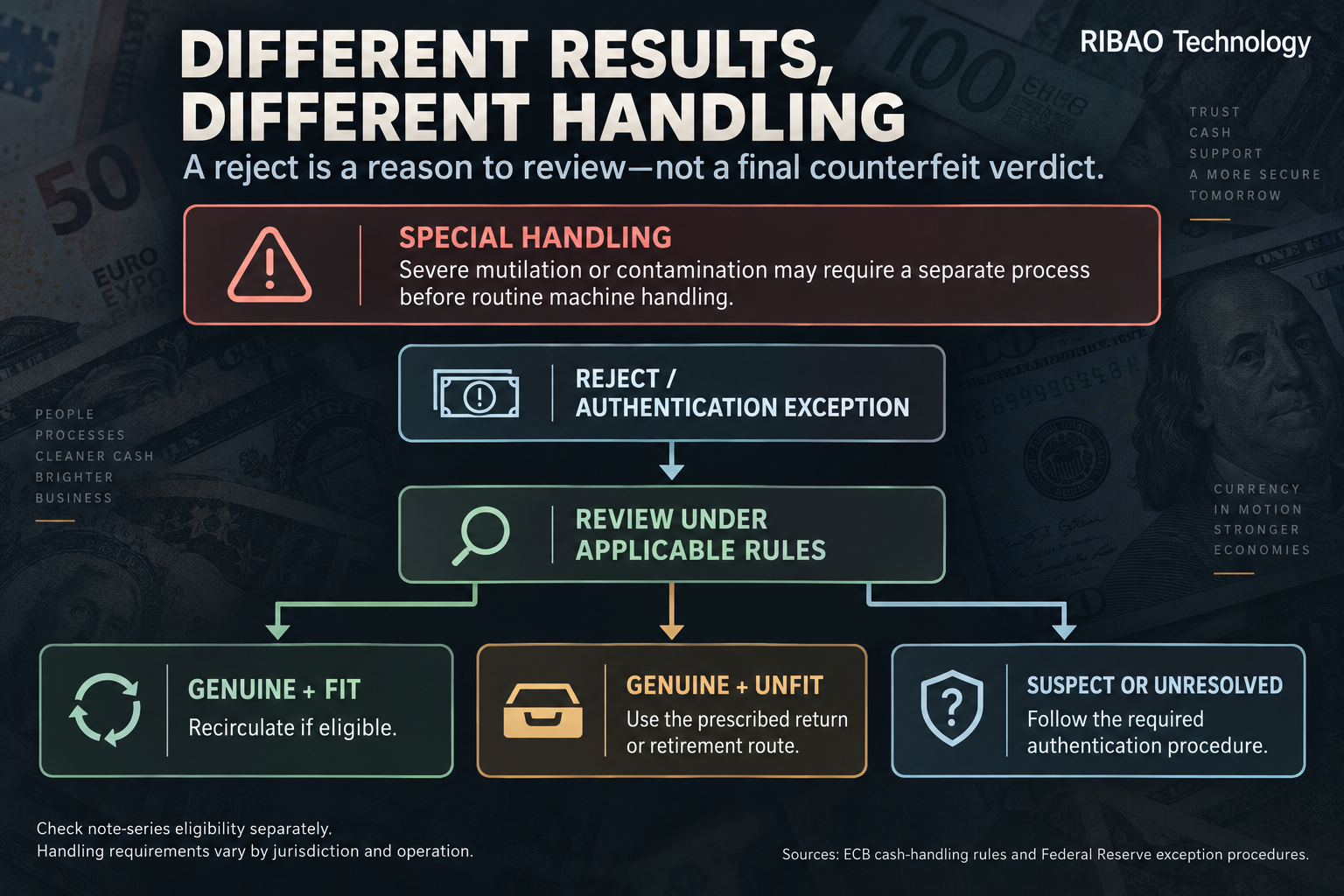
A classification is useful only when the operator knows what happens next. The following routes describe distinct decisions; they are not a universal sequence that every cash-handling machine follows.
A genuine note that passes the applicable fitness checks may return to circulation, provided its series and intended use also meet the relevant requirements. Physical condition is one part of that decision.
A note may be genuine but fail the required physical quality standard. Separate it from cash approved for recirculation and use the prescribed return or retirement route. A commercial operator should not treat an unfit result as independent authority to destroy the note.
For an overview of the subsequent stage, see Why Banknote Retirement Is Critical to Monetary Integrity. This article focuses on the earlier decision: which notes should leave the recirculation stream.
A failed authentication check or an unclear reading is an exception requiring review. It is not, by itself, a final determination that the note is counterfeit. Review it under the operator's procedure and applicable rules, including referral to the competent authority where required.
The euro banknote handling framework, for example, distinguishes suspected counterfeits, notes that cannot be clearly authenticated, and genuine notes classified as fit or unfit. The categories have different handling requirements.
Severe damage may require a specialized examination or redemption process. In the United States, the mutilated currency procedure is distinct from ordinary unfit-note processing.
Contaminated currency can involve health or safety risks. Ordinary dirt or a stain does not automatically make a note contaminated. Where required, identify and handle these notes separately before routine machine processing.
Series eligibility is another policy check. A note can be physically sound but excluded from a particular redistribution process. That policy status should be recorded separately from damage; exclusion from redistribution does not, by itself, establish that the note has lost legal-tender status.
At higher volumes, cash handlers need a repeatable way to apply defined inspection rules. Equipment with verified banknote fitness sorting functions can help separate notes by condition and direct exceptions to the appropriate output or review process.
A denomination sorter and a fitness sorter do different jobs. As explained in Different Types of Cash Handling Machines, denomination, face or orientation sorting does not establish that a machine can assess physical fitness. A reject pocket also describes an output route; its presence does not prove any particular fitness detection capability.
The operating value depends on the complete workflow. Defined settings, staff training, maintenance and documented exception handling can support consistency. Any reduction in manual review should be assessed in a representative trial. Reporting and traceability should likewise be confirmed as available functions, rather than assumed from the machine's category name.
Evaluate the configuration that will actually be delivered: model, currency, banknote series, software version and enabled settings. A demonstration on another currency or configuration does not establish performance for your operation.
Use the supplier discussion to turn "fitness sorting" into a clear, testable requirement:
Define the destination and standard. Which currency, note series and recirculation use must the operation support? Who sets the applicable quality requirements?
List the required condition checks. Ask which defects are detected automatically, which need manual review, and what evidence supports each claimed function.
Confirm the proposed configuration. Record the model, software version and enabled checks. Where official test results are relevant, verify their listed currency and configuration rather than treating a listing as a blanket endorsement.
Demonstrate the output routes. Ask how genuine fit notes, genuine unfit notes and unresolved authentication exceptions are separated in the selected mode. Confirm how operators identify and review exceptions.
Agree a representative acceptance trial. Use an approved sample set covering the operation currencies, series and relevant conditions. Agree reference classifications, review disagreements and record throughput and reprocessing under the tested settings.
Check ongoing support. Clarify cleaning, maintenance, setting control, software updates and operator training. Confirm any reporting or record-export functions needed by the workflow.
The objective is to match the required decisions to verified equipment functions and an operating procedure that staff can follow.
Contact RIBAO Technology with your currencies, banknote series, processing volume, required condition checks and intended output workflow. These details provide a basis for discussing an appropriate configuration and the evidence needed to evaluate it.

